Posts

Recent Rarities (Western Tanager, Harris's Sparrow, Pink-footed Goose, Lesser Yellowlegs)

Image
Over the past two days Carolyn Sedgwick and I have enjoyed some luck chasing a few nice local birds. I was overdue, as I hadn't chased a bird in Connecticut in weeks (months?). It was nice to get out and see a few goodies, with relative ease, no less. Today (27 Feb) Maggie Jones was very kind to allow us to view and confirm identity of a WESTERN TANAGER that had first visited her yard in Mystic yesterday. We walked up the driveway until the feeders were in view, immediately locating the bird. It proceeded to fly-catch around the yard with intermittent visits to the suet feeder. (Yes, there were flying insects about today. It was a balmy 50 degrees, unusually warm but typical of this very mild winter. Had my first butterfly of the year here - Mourning Cloak.) A very cooperative bird. We left it alive and well after a half-hour of viewing, though an immature Cooper's Hawk was eying the feeders from afar. Hopefully the WETA can keep safe even though it sticks out like a sore thumb...
Shoot first, ask questions later??

You may have noticed that with digital cameras of all shapes and sizes becoming more and more affordable, a growing percentage of birders are arming themselves with impressive photography equipment in the field. It's not uncommon to see someone (like myself) dragging binoculars around their neck with a spotting scope over one shoulder and a digital SLR on the other. Many others carry a point-and-shoot in their pocket for digiscoping. This is a promising trend, as a greater proportion of rare and scarce birds are being documented. It certainly makes records committee evaluations that much easier! But there is a healthy debate that is growing in the birding community. Some (many?) birder-photographers have adopted a 'shoot first, ask questions later' philosophy in the field. I have personally seen birders, without even trying to identify the bird with optics, immediately pull up their cameras and fire away as many shots as they can, with apparently little interest in watching...

11 Feb - adult Kumlien's Iceland Gull

Image
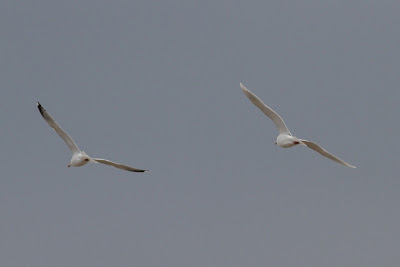
On Saturday afternoon Carolyn Sedgwick and I birded the central CT coast and stumbled upon a nice adult Kumlien's Iceland Gull at Circle Beach near the end of Neck Road on the Madison/Guilford line. It's one of the more lightly-marked adults I've seen locally in recent years, with limited gray on p7-p10. In fact when first seen naked eye we took it to be completely white-winged, only to notice the dark pigment with optics. A rather pale iris as well. Skies were overcast and the bird was hesitant to come in to popcorn and potato chips, but we did enjoy a few nice flybys. adult "Kumlien's" Iceland Gull - NB

CT "pelagic" trip

Image
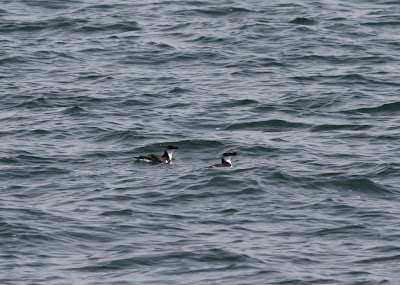
This morning 42 birders boarded Project Oceanology's 65-foot boat out of Groton, CT to explore the Connecticut waters of eastern Long Island Sound (thanks to Phil Rusch organizing a trip sponsored by the Connecticut Ornithological Association ). An organized CT boat trip has not been run in many years. Why the special occasion? From late-December through mid-January, an unprecedented incursion of winter pelagic birds was noted in the middle of eastern LI Sound along the CT/NY border by birders who rode the ferry from CT to Long Island. During this period birders recorded several Black-legged Kittiwakes and Common Murres and at least two Thick-billed Murres. In addition to the rarities were impressive numbers of Northern Gannets, Razorbills, and both loons. Even Minke Whales were reported from the area!! Clearly there was an abundant food source to be consumed. Phil's brilliant plan was to charter a boat and spend a few hours working this stretch of Long Island Sound. He found a...

Jan 8 - good January birds

Image
Doug Gochfeld and I birded some southern CT location on Sunday morning from 0730 to 1230. We started off in Wallingford searching for geese around MacKenzie Reservoir. We had the continuing adult Greenland GREATER WHITE-FRONTED GOOSE and two "Richardson's" CACKLING GEESE. Other waterfowl on the res included a pair of LESSER SCAUP. Greater White-fronted Goose From there we moved toward the coast in search of lingering or rare passerines. Our first stop was at Ora Ave/Proto Dr in East Haven. The place was birdy but nothing too unusual around. Highlights included both kinglets, Gray Catbird, and Savannah Sparrow. We finished at East Shore Park in New Haven, locally famous for lingering warblers and swallows. Sure enough we found the following lingerers: 3 (!) NASHVILLE WARBLERS, 4 Yellow-rumped Warblers, a "Western" Palm Warbler, and a YELLOW-BREASTED CHAT. On our walk back from the western border of the park, a NORTHERN ROUGH-WINGED SWALLOW flew in and began to fe...

Jan 7 - interesting Herring Gull at the landfill

Image
On Saturday afternoon a group of us visited the Windsor-Bloomfield Landfill. We had three really nice-looking "Kumlien's" Iceland Gulls (first cycle, second cycle, adult), but I found the gull photo'd below the most interesting of the day. It's a first cycle "Herring" Gull. But it shows some features more in line with Old World taxa (perhaps European Herring Gull) than with your typical smithsonianus American Herring Gull. The bird stuck out among the American HERGs of various ages by its frosty upperparts with thinly barred first-winter scapulars and checkered greater coverts. A closer look revealed pointy blackish primaries and a mostly black bill, and a blackish tail band of unknown width. Tertials were strongly notched laterally and had broad white tips distally. Undertail coverts barred dark and white, with white bars averaging wider than the dark ones. In flight, we see an obvious pale inner primary window. The inner primaries are strikingly patter...

Book Review: "The Birds of New Jersey: Status and Distribution"

[Disclosure: A free copy of this book was provided by Princeton University Press for unbiased review.] Status and distribution. Those two words probably excite me more than I should admit. If you don’t feel the same way, you might wonder why I would be eager to review this book. I don’t live in New Jersey. I rarely bird in New Jersey. And let’s face it, New Jersey simply leaves a lot to be desired. Just ask former NY Governor Paterson . But if you are like me (you poor, poor bastard), you live for this stuff. “The Birds of New Jersey: Status and Distribution” (paperback, 308 pages) by William J. Boyle, Jr. is a comprehensive look at the documented S&D of New Jersey’s avifauna. This type of book has been done before for many states – every state really should have a work like this at its disposal. The book starts with an introduction, proceeds to the annotated species list, and concludes with a few appendices. The intro is straightforward and to-the-point. We are given a summary ...